Benefits of In-Home ABA Therapy vs. Center-Based Therapy
Choosing the Right Setting: How Environment Shapes Your Child's Progress
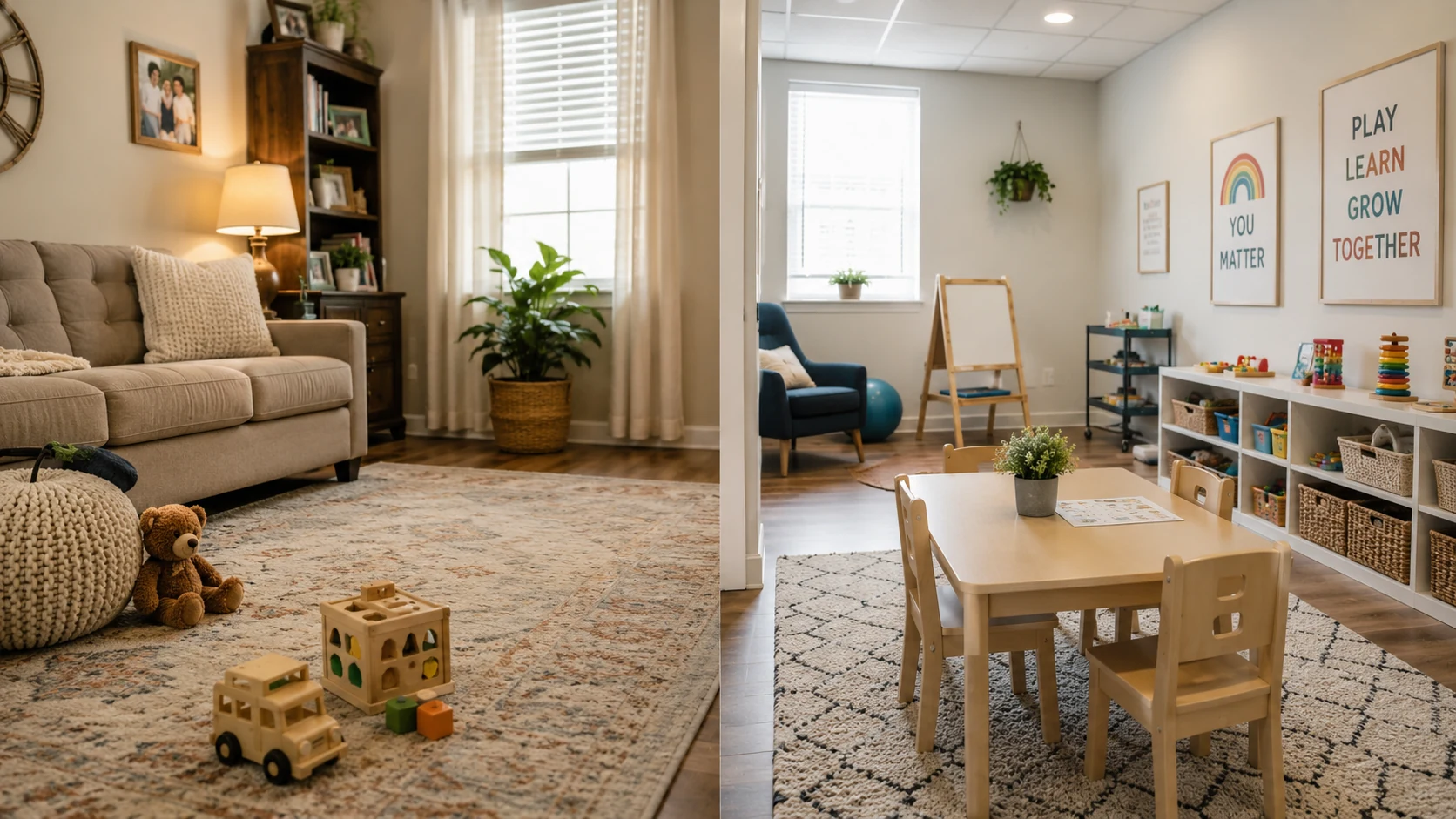
Understanding Why Setting Matters in ABA
Families beginning Applied Behavior Analysis are often presented with a choice between in-home services and a center-based program, and the decision can feel weightier than it should. Both models rest on the same scientific foundation, use the same techniques, and are delivered by the same credentialed professionals. What differs is the environment — and environment influences which skills are easiest to teach, how naturally those skills transfer to real life, and how much the family can participate. Neither setting is universally better. The productive question is not which model is superior, but which one matches your child's current needs and your family's circumstances.
The Case for In-Home ABA Therapy
Why does the natural environment matter?
Children with autism frequently struggle with generalization — applying a skill learned in one setting to a different one. A child who reliably requests a snack at a clinic table may not do so in their own kitchen, because the room, the people, the materials, and the routine have all changed. In-home therapy sidesteps much of this problem by teaching the skill where it will actually be used.
Getting dressed is taught in the bedroom with the child's own clothes. Toothbrushing happens at the family's sink. Mealtime behaviors are addressed at the table the family actually eats at. The skill and its context are learned together, which reduces the additional work of transferring it later.
How does in-home therapy support the whole family?
The home setting brings parents and siblings into the process almost automatically. Parents can observe sessions directly, ask questions in the moment, and receive coaching on strategies while the relevant situation is unfolding. This matters because parent-implemented strategies are among the strongest predictors of durable outcomes. A parent who has watched a technique work in their own living room is far more likely to use it correctly on a Tuesday evening when the therapist is not present.
Siblings can be incorporated into social and play goals in a way that is difficult to replicate in a clinic. Family routines — bedtime, mealtimes, getting out of the door in the morning — become the actual curriculum rather than a topic discussed in a progress meeting.
What practical advantages does the home offer?
The logistical benefits are substantial. There is no commute, which matters enormously for children who find car travel distressing and for families managing work schedules or other children. Scheduling tends to be more flexible, and sessions can be timed to target specific daily challenges — an early-morning session to work on the getting-ready routine, or an evening session to address bedtime resistance.
For children with significant sensory sensitivities, medical needs, or high anxiety around unfamiliar environments, the home removes a substantial barrier to engagement. A child who spends the first twenty minutes of every clinic session recovering from the transition is losing meaningful therapy time.
The Case for Center-Based ABA Therapy
How does a center support social development?
The clearest advantage of a center is peer access. Group activities, structured social skills sessions, turn-taking with other children, and incidental interactions during transitions are all readily available. For a child whose primary goals involve peer relationships, sharing, cooperative play, or navigating group dynamics, a center provides opportunities that a home simply does not contain.
Why does a controlled environment help some children?
Centers are purpose-built. Distractions are minimized, materials are organized and abundant, and the space is designed around therapeutic activity. For children who are highly distractible, or who have learned to escape demands using home-specific strategies — retreating to a bedroom, seeking a parent, accessing preferred items independently — the structure of a center can support faster acquisition of new skills.
Centers also make certain resources practical that would be difficult to provide in a home: sensory rooms, gross motor equipment, dedicated therapy materials, and space for a variety of activity types.
What staffing advantages exist in a center?
A center typically has multiple technicians and supervising analysts on site. That means immediate access to a BCBA when something unexpected occurs, easier coverage when a technician is unavailable, and straightforward coordination with occupational or speech therapists working under the same roof. Working with several different technicians also has a therapeutic benefit — it builds tolerance for variation and reduces dependence on a single familiar adult.
For families, a center offers something else that is rarely discussed openly but frequently matters: respite. Caregiving is demanding, and hours in which a child is safely supported elsewhere have real value for parents' capacity to sustain everything else.
- Skill generalization — In-Home ABA: Strong for daily living and family routines | Center-Based ABA: Requires deliberate transfer planning
- Peer interaction — In-Home ABA: Limited to siblings and arranged visits | Center-Based ABA: Built into the daily structure
- Parent involvement — In-Home ABA: High and continuous | Center-Based ABA: Scheduled training sessions
- Distraction level — In-Home ABA: Higher, but realistic | Center-Based ABA: Controlled
- Family logistics — In-Home ABA: No travel, flexible timing | Center-Based ABA: Requires commute and fixed schedule
- Resources and equipment — In-Home ABA: Limited to what the home contains | Center-Based ABA: Extensive and purpose-built
- Best suited to — In-Home ABA: Daily living, self-care, routine-based and family goals | Center-Based ABA: Social skills, school readiness, group tolerance
Making the Decision for Your Family
Which factors should guide the choice?
Start with your child's most pressing goals. If the priority list is dominated by toileting, dressing, sleep, mealtime behavior, or managing transitions within family routines, the home is the logical setting. If it centers on peer play, following group instructions, tolerating a classroom-like structure, or preparing for school entry, a center has clear advantages.
Age is relevant. Very young children often benefit from beginning at home, where security is highest and family involvement is most influential. As children approach school age, the school-readiness benefits of a center become more compelling.
Practical realities are legitimate factors, not compromises. Insurance coverage, provider availability in your area, travel distance, work schedules, and the presence of other children all shape what is genuinely sustainable. A theoretically ideal plan that a family cannot maintain is worse than a good plan they can.
Is a hybrid model an option?
Increasingly, yes. Many providers now offer combined programming — center hours for social and group-based goals, home hours for daily living skills and parent training. This captures much of the benefit of both, though it requires more coordination and is not available everywhere.
Can the setting change over time?
It should. A child's needs at three are not their needs at six. Families often begin at home to establish rapport and foundational skills, then add center hours as school approaches, then reduce intensity as goals are met. Treatment settings are reviewed alongside treatment plans, and raising the question with your BCBA at any point is entirely appropriate.
Focusing on Fit Rather Than Ranking
The comparison between in-home and center-based ABA is often framed as a contest, when it is more accurately a matter of alignment. Both models deliver evidence-based intervention. What determines outcomes is whether the setting supports the specific skills your child needs, whether it enables the family involvement that sustains progress, and whether it fits realistically into your family's life. Discuss your goals openly with your BCBA, revisit the arrangement as your child develops, and treat the setting as one adjustable element of a plan rather than a permanent commitment.
References

Need Support? We're Here to Help
Our dedicated team provides personalized ABA therapy to help your child thrive. We make access to quality care simple and effective.
Contact us today to start ABA therapy.
Recent articles




Autism Scripting: Decoding a Unique Communication Tool

Ways Autism Shapes Learning Experiences