
How ABA Goals Carry Over at Home, School, and Therapy
Autism goals at home and school may look different, but they work toward the same skill. Learn how to support progress across all settings.

Key Points:
- Autism goals at home and school often look different from therapy sessions, but they're still working toward the same skill.
- Different settings bring unique demands that make practiced behaviors harder to perform in new environments.
- When families, teachers, and therapists use similar cues and support, children build independence across all settings.
It can be confusing when a child asks for help during therapy but goes quiet in class or gets frustrated at home. It might even feel like the goal isn't working, but that is rarely the case.
Usually, the goal is still the right one; it’s just the setting that changed. New environments often make the same skill feel much more demanding for a child. That is why autism goals at home and school may look different from what you see in therapy, even when everyone is working toward the same result.

Why Using Skills in Different Places Helps ABA Goals Work in Real Life
A goal is most meaningful when your child can use it with different people and throughout their actual daily routines. While therapy is where a skill is often first taught, good ABA therapy services help it become part of everyday life at home and school.
When a skill works in more than one place, it turns a practiced behavior into a natural habit. Whether it is asking a teacher for help, transitioning at bath time, or following directions at the store, these moments build your child’s independence and confidence.
You are in good company. The CDC reports that 1 in 31 children aged 8 years in the U.S. has been identified with autism. Many families and schools are working through these same daily concerns together.
The most effective goal setting for autism usually comes down to one simple question: Can this skill help my child at home, at school, and everywhere else?
Why Autism Goals at Home and School Can Look Different From Therapy
A goal does not need to look the same in every setting to still be the same goal. Different places simply bring different demands.
Autism Goals at Home and School Use Different Demands
- At Home: This is a safe, familiar space. While that comfort helps, it also means habits are strong. Switching from a favorite tablet to a "hard" task like getting dressed can feel like a bigger struggle because the home routine is so deeply set.
- At School: The "hustle and bustle" adds layers of difficulty. Between the noise, the waiting, and the social pressure, a skill a child has mastered at home might suddenly feel much harder to perform.
- In Therapy: This is a controlled "practice zone." With fewer distractions and a therapist providing specific prompts, it’s easier to focus on small, manageable steps.
Your child is not failing when the setting changes. The setting changes what the skill asks from them.
Statistics show how common this is. In 2022, 95% of students served under IDEA were in regular schools, and 67% spent most of their day in general classrooms. For most families, practicing skills in the middle of a busy school day is a practical, everyday reality.
One Goal, Three Settings: What It Can Look Like Day to Day
A running example makes this easier to picture. Let’s look at how one goal, like asking for help, adapts to different settings. The goal stays the same, but the words and support change.
Example 1: Asking for Help
- At Therapy: This might happen during a puzzle or a game. The therapist might pause and wait or give a small prompt to help the child along.
- At Home: This often happens when a snack bag won't open or a toy is stuck. A caregiver can use the same short cues recommended by the BCBA to keep things consistent.
- At School: A child might raise their hand or use a "help card" during art or classwork. The teacher responds in a way that fits the child’s in-school support plan.
Example 2: Moving Between Activities
- At Therapy: Shifting from table work to play.
- At Home: Moving from screen time to dinner or a bath.
- At School: Changing from centers to group instruction.
The core skill is learning how to move from one task to the next without a struggle when the routine shifts. While the people and cues change, the goal remains the same. This is what professionals call generalization in ABA.
To most families, it is even simpler: “Can my child use this skill in real life too?”
What Should Stay Consistent Even When the Setting Changes
Consistency doesn't mean copying everything word for word. It means keeping the core parts of the goal aligned so your child recognizes what they're working on.
What should stay similar:
- The same skill target. If the goal is asking for help, everyone works on asking for help, not something completely different.
- Similar cue or simple wording. Adults can use phrases like "What do you need?" or "Can you ask?" so your child hears familiar prompts.
- Similar idea of what counts as success. If your child can point and say one word at therapy, home and school should accept that, not require full sentences.
- Similar response when your child does it right. Praise, a high-five, or access to what they asked for should follow the skill.
- Clear communication about what support was needed. Share whether your child needed a physical prompt, a verbal cue, or no help at all.
School and ABA goals do not have to be exact copies of each other. It is often more helpful to simply make sure they support the same general skill.
Since IDEA guidelines require IEPs to be based on a child’s specific needs and current levels, school goals should always be personal to them. When everyone maintains positive expectations across every setting, it gives your child the confidence they need to try those new skills in different places.
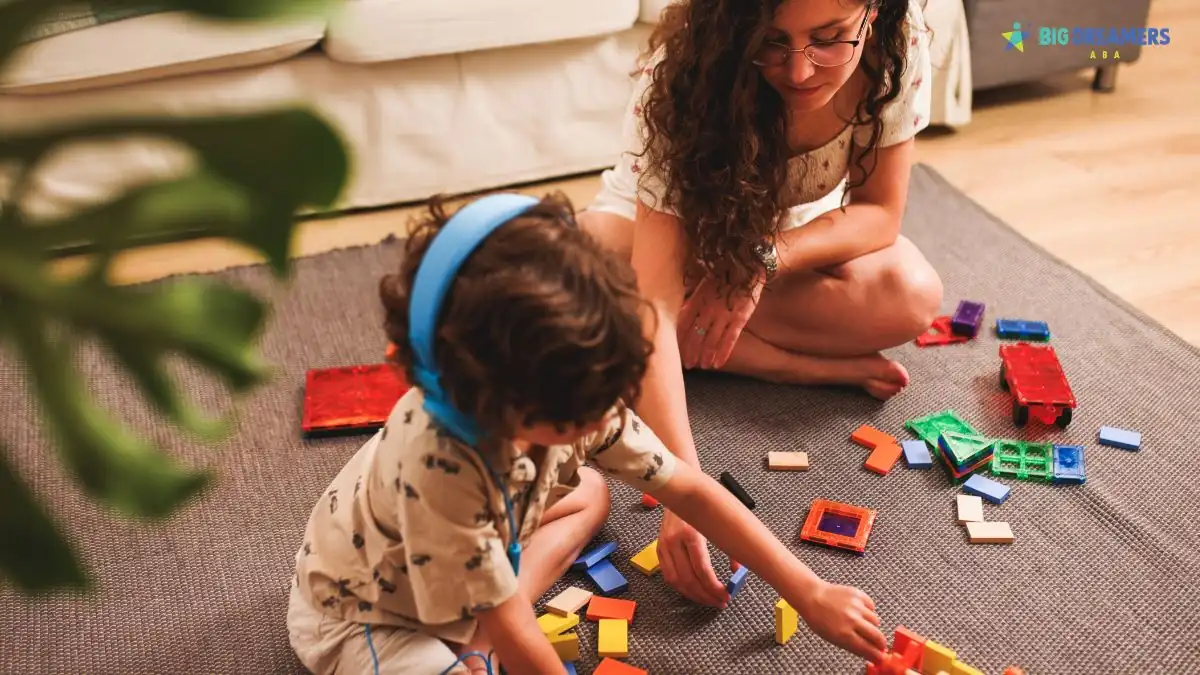
How Parents Can Help Without Turning Home Into Therapy Time
You don't need to turn your house into a clinic. Small, natural steps can help your child practice goals at home:
- Pick one routine: Choose snack time, bedtime, or homework rather than trying to juggle five routines at once.
- Use the right words: Ask your BCBA for the exact phrase they use. This keeps things familiar and clear for your child.
- Check in with school: Ask staff what support helps most during the day. If it works there, it might work at home too.
- Keep it brief: Two minutes during a real routine is often more effective than a long drill.
- Talk to the team: Share the small wins and the hard moments. Good parent-therapist collaboration helps everyone see what is actually working.
- Adjust when needed: If a goal works in only one place, it may need smaller steps or different support.
- Make it fun: Using favorite toys, activities, or simple choices helps practice feel less like work.
Research shows this approach makes a difference. A meta-analysis of caregiver-implemented interventions found 51 effect sizes with moderately strong benefits for child outcomes. Follow-through works best when families have clear coaching and steps.
Signs a Goal Is Working in Different Places and Signs It May Need a Reset
Here is a look at how to monitor progress and tell if a goal is moving forward or if it might be time to adjust the approach.
Signs of Progress Across Settings
- Using it with different people: Your child asks a caregiver, teacher, and therapist for help.
- Needing fewer reminders: They start asking before you have to step in.
- Trying it in new routines: The skill shows up at the park, not just at the kitchen table.
- Taking the lead: They use the skill on their own before an adult prompts them.
Signs the Team May Need to Adjust
- It only happens in therapy: The skill hasn’t made the jump to home or school yet.
- It depends on one specific cue: They only respond to one person or one exact phrase.
- Goals are defined differently: One setting expects a gesture while another expects a full sentence.
- The routine is too hectic: If the environment feels too fast or difficult, there isn't enough space or time to practice.
A stalled goal doesn't mean your child isn't making progress. It usually just means the team needs to look at smaller steps, different supports, or a more natural fit for that specific setting.

FAQs About ABA Goal Carryover Across Settings
How long can it take for an ABA goal to carry over to another setting?
An ABA goal can take weeks or months to work in different settings, depending on the skill, the place, and how much support the child needs. A skill often works faster in new places when adults use similar cues, practice happens during real routines, and the team reviews progress often.
Does a child need to master a goal in therapy before using it at home or school?
No, a child does not always need full mastery in therapy before using a goal at home or school. Many children start practicing a goal in different settings while it is still developing, as long as the team keeps the expectations clear and the support level appropriate.
What should parents share when home and school see different results on the same goal?
- Share when the skill happens
- Share what prompt was used
- Share who was there
- Share what happened right before
- Share what helped
- Ask whether the goal or support needs adjusting
Build Progress Across Every Setting
A goal means more when your child can use it in real life, not just during a therapy session. While home, school, and therapy look different, the right plan keeps everyone working on the same skill.
At Big Dreamers ABA, we provide home, school, and center-based support for families in Georgia and Maryland. We help build goals that fit into daily routines in every setting. By working with caregivers and teachers, we make sure the skills your child learns are there for them when it counts.
Reach out to talk about goals, routines, and the support your child needs at home, in school, and during therapy. We will help you create a plan that works in every setting your child moves through each day.

Need Support? We're Here to Help
Our dedicated team provides personalized ABA therapy to help your child thrive. We make access to quality care simple and effective.
Contact us today to start ABA therapy.
Recent articles

Concurrent Schedules Of Reinforcement

The Role of Token Economies in Motivating Positive Behavior
