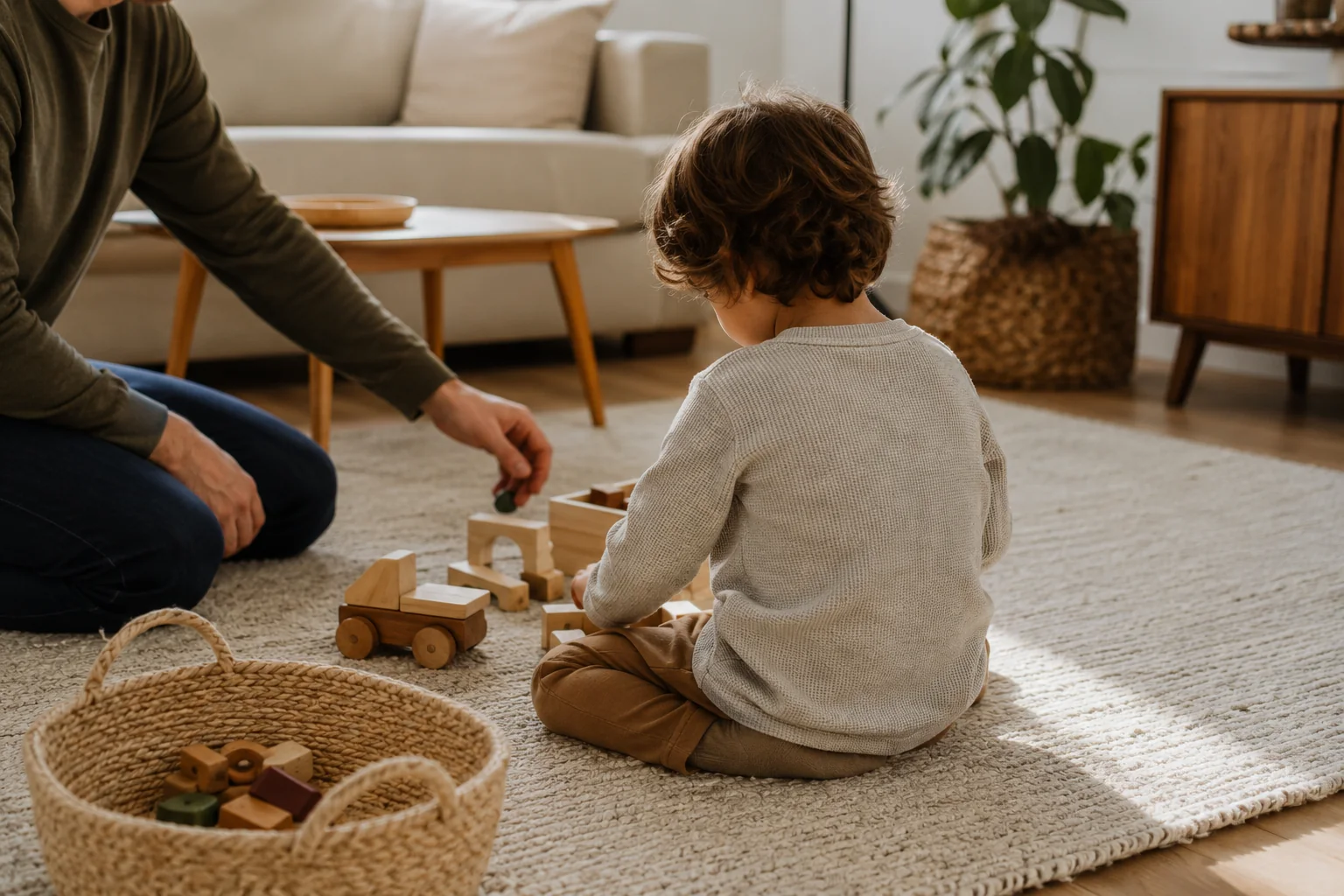
What to Expect During Your Child's First ABA Therapy Session at Home
A Parent's Guide to Day One: Calming the Nerves and Knowing What Comes Next

Understanding Communication as a Behavior
Applied Behavior Analysis approaches language differently from most other frameworks. Rather than treating words as vocabulary to be memorized, ABA treats communication as behavior — something a child does because it produces a result. A child says "juice" and juice appears. That outcome is what makes the word worth using again.
This shift has practical consequences. It explains why a child might name a hundred pictures in a book yet never ask for anything: labeling has been taught, but requesting has not, and the two are functionally different skills. It also explains why challenging behavior so often decreases as communication improves. Screaming and requesting can accomplish the same thing, and children reliably use whichever works better. Teaching an efficient alternative is one of the most effective interventions available.
The Foundations of Communication Instruction
What are verbal operants and why do they matter?
ABA divides language into functional categories, drawn from B.F. Skinner's analysis of verbal behavior. The core categories are:
Mands — requests. Asking for something the child wants. This is nearly always taught first, because it delivers an immediate, meaningful outcome and therefore motivates the child powerfully.
Tacts — labeling. Naming objects, actions, or properties in the environment. "Dog." "Running." "Red."
Echoics — vocal imitation. Repeating a sound or word after someone else, which builds the motor foundation for speech.
Intraverbals — conversational responses. Answering questions, completing phrases, and responding to what someone else has said. This is the most complex category and underpins genuine conversation.
Progress is not always even across these categories. A child may mand fluently while struggling with intraverbals, which is why assessment examines each separately rather than measuring language as a single score.
Why does requesting come first?
Manding is prioritized because it is inherently reinforcing. When a child says "ball" and receives the ball, the connection between communication and outcome is immediate and unambiguous. No external reward is needed — the request produces its own consequence.
This early success also builds motivation to communicate at all, which is often the underlying barrier. A child who has learned that speaking produces useful results becomes a more willing participant in everything that follows.
Core Techniques Used to Build Language
How does natural environment teaching work?
Natural Environment Teaching, or NET, embeds instruction into activities the child is already engaged in. If a child is playing with bubbles, the therapist pauses and waits for a request before blowing more. If a child reaches for a snack, an opportunity to request is created. The context is real, the motivation is genuine, and the skill is learned where it will be used.
NET is frequently paired with more structured Discrete Trial Training, in which skills are broken into short, repeated, clearly defined trials with immediate feedback. DTT builds fluency efficiently; NET builds generalization. Most quality programs use both.
What is incidental teaching?
Incidental teaching involves deliberately arranging the environment to create communication opportunities. A preferred toy is placed in view but out of reach. A snack is offered in a container the child cannot open. A puzzle is handed over with a piece missing. Each situation creates a natural reason to communicate — and the child's response is then shaped toward a clearer, more independent form.
How does prompting and fading support new skills?
When a child cannot yet produce a response independently, the therapist provides a prompt: a full model ("say ball"), a partial sound cue, a gesture, or physical guidance for signing. As the child succeeds, prompts are systematically reduced.
Fading is essential and frequently underappreciated. Without it, children become prompt-dependent — waiting for the cue rather than initiating. A well-designed program plans the fading sequence from the start rather than treating it as an afterthought.
How is shaping used for speech sounds?
Shaping reinforces successive approximations toward a target. A child working toward "water" might first be reinforced for "wa," then "wa-er," then the complete word. This keeps the child succeeding rather than failing repeatedly at a target that is currently out of reach, which protects motivation as much as it builds articulation.
- Manding instruction — What It Involves: Teaching requests for preferred items | Primary Benefit: Immediate, self-reinforcing communication
- Natural Environment Teaching — What It Involves: Instruction embedded in real activities | Primary Benefit: Strong generalization
- Discrete Trial Training — What It Involves: Short, structured, repeated trials | Primary Benefit: Efficient skill acquisition
- Incidental teaching — What It Involves: Arranging situations that require communication | Primary Benefit: Builds initiation
- Prompting and fading — What It Involves: Graduated support, systematically withdrawn | Primary Benefit: Independence
- Shaping — What It Involves: Reinforcing closer approximations | Primary Benefit: Sustains motivation during difficulty
Supporting Children Who Are Not Yet Vocal
What is augmentative and alternative communication?
Not every child develops spoken language on a typical timeline, and communication should never be delayed while waiting. Augmentative and Alternative Communication includes picture exchange systems such as PECS, speech-generating devices, and sign language.
A persistent concern among parents is that introducing AAC will discourage speech. Research consistently finds the opposite: children provided with AAC are more likely to develop vocal language, not less. Giving a child a functional way to communicate reduces frustration, builds the understanding that communication produces results, and often supports vocal attempts alongside the alternative system.
How does ABA address non-verbal communication?
Communication extends well beyond words. Programs commonly target eye contact and joint attention, gesture use including pointing and waving, appropriate physical proximity, and recognition of facial expressions and tone. These skills are taught through modeling, video modeling, structured practice, and reinforcement in the same way vocal skills are.
Moving Toward Conversation
How are social communication skills developed?
As foundational skills stabilize, goals shift toward conversational competence: initiating an interaction, taking turns in dialogue, staying on topic, asking questions, and repairing misunderstandings. Techniques include social stories, role play, video modeling, and structured peer practice with gradually reduced adult support.
What role do parents play?
A substantial one. Communication skills are learned in the environments where they are used most, and that is the home. Practical strategies parents apply between sessions include pausing during routines to create a requesting opportunity, avoiding anticipation of every need before the child asks, modeling language slightly above the child's current level, and reinforcing every communication attempt — including imperfect ones. Responding to a partial word as though it were a full request is one of the most powerful things a parent can do.
How is progress measured?
Data collection is continuous. Therapists record mands per session, independent versus prompted responses, vocabulary expansion, mean length of utterance, and generalization across people and settings. This data drives decisions about when to advance a goal, when to adjust an approach, and when a technique is not working — which is the mechanism that keeps a program responsive rather than static.
Building Language That Lasts
The value of ABA's approach to communication lies in its treatment of language as functional rather than decorative. Skills are taught because they give the child access to things that matter — a preferred item, an adult's attention, a way out of an overwhelming situation, a connection with another child. Progress is measured, strategies are adjusted when the data says they should be, and instruction happens across the settings where communication actually occurs. For families, the most meaningful outcome is rarely a vocabulary count. It is the moment a child asks for something instead of screaming for it, and the entire family's day becomes different as a result.
References
- Applied Behavior Analysis (ABA) | Autism Speaks
- American Speech-Language-Hearing Association
- Behavior Analyst Certification Board
- Autism Spectrum Disorder | CDC
- Autism Society
Need Support? We're Here to Help
Our dedicated team provides personalized ABA therapy to help your child thrive. We make access to quality care simple and effective.
Contact us today to start ABA therapy.
Recent articles

How Positive Reinforcement Works in ABA Therapy
What Parents Can Do Between ABA Sessions to Support Progress